
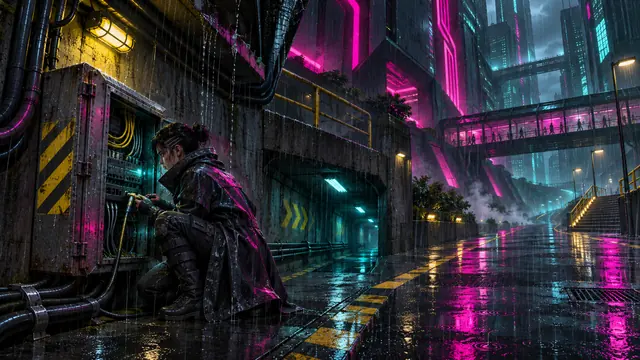
Illustrated relationship, not a live network. Use arrow keys to compare.
A corporate network begins somewhere physical. Beneath the towers, a cabinet waits behind a service door, a maintenance corridor crosses a public walkway, and a street runner has to reach the connection before deciding what to do with it. Neomod Studios develops cyberpunk game concepts around that relationship between the visible city and the systems behind it. The rain is more than atmosphere: shelter, sound and reflected light can change how a route is read.
Street view / network view
The proposed interface keeps two kinds of evidence close together. Street view shows the place a runner occupies, including sightlines and exits. Network view shows the limited connections available from that position. Switching perspective should reveal a different relationship, not teleport the character into a separate puzzle room. A player who traces a useful connection still needs to consider the exposed doorway beside their shoulder.
Rainsplice: a connection with a way out
In Rainsplice, the runner scouts a corporate service district before committing to a short intrusion. Access points offer different opportunities and different exit conditions. The concept asks how much information is enough to act, and how the city can explain rising attention without relying on an unexplained global alarm bar. Leaving with a partial result can be a deliberate outcome rather than an automatic failure.
Service Ghost: work that passes unnoticed
Service Ghost follows the routines that keep a dense tower district operating. The runner studies service windows, temporary permissions and the movement of repair crews. A convincing path depends on understanding where an action belongs in an ordinary process. The proposed play is about timing and context, not a real-world guide to compromising systems. All networks, organisations and access mechanisms are fictional.
Show the cost before the commitment
We want warnings that identify what changed. A cabinet can close its maintenance window; a corridor can become occupied; a connection can become too narrow for the intended action. Those changes should be visible at the relevant place. The Street Lab describes how we connect art direction, route design and interface feedback so that a bright city does not become an unreadable one.
Follow the questions under revision
The Change Signals record separates observations, proposed changes and unresolved checks. These pages describe concepts and design reasoning. They do not announce a shipped game, a public demo or a release date. Use the access-route dossiers to understand the proposed loops, then follow a design note to see which assumptions still need a prototype.