
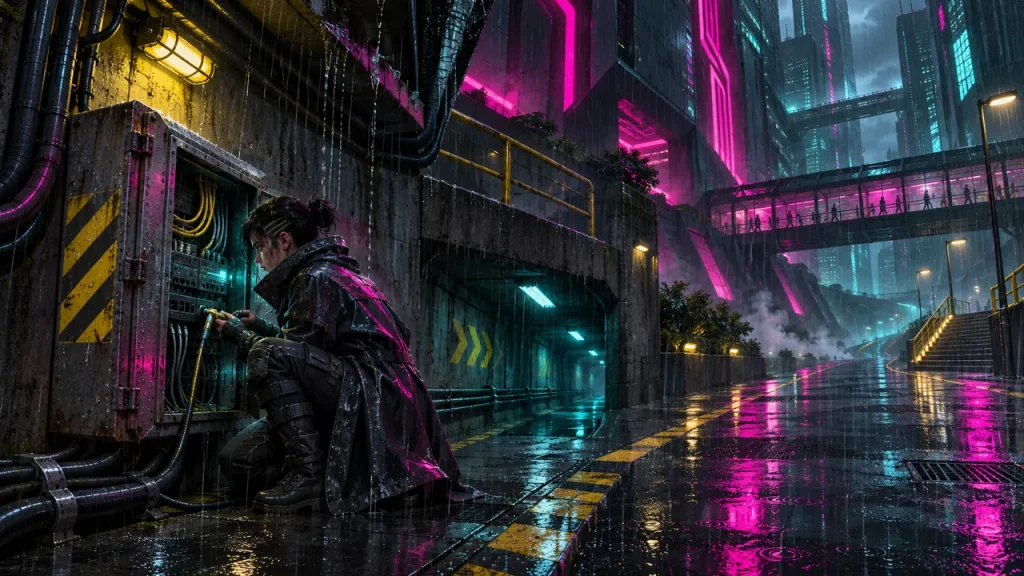
Rainsplice is a cyberpunk intrusion concept about choosing a place to connect and retaining a way to leave. The player is a street netrunner beneath a corporate tower district. Connections are local, opportunities are limited and the body remains in the street while the interface is open. This page describes a proposed game loop and visual direction; there is no announced release date or playable public build.
Reconnaissance before the cable
The first task is to understand a small physical area. A sheltered cabinet, an exposed junction and a service entrance offer different access conditions. The player can inspect the nearby walkways and identify where a retreat would lead. We want the scouting phase to produce a plan the player can explain in ordinary language: this point reaches the useful branch, this doorway creates exposure, and this passage remains the fallback. The scene should not demand a complete map of the corporation before a local decision becomes possible.
A limited view into the network
Connecting reveals the branches available from that point, not an omniscient diagram of every system. A branch might provide a status record, a temporary route or a question that requires another physical location. The player chooses an objective whose scope is visible. A fictional interface can make these relationships legible without copying real intrusion procedures. The design goal is a tactical decision about commitment, attention and information, rather than an educational simulation of compromising an actual network.
Pressure with an identifiable source
An intrusion should not become dangerous merely because a hidden timer has advanced. The concept uses local changes: a maintenance window is ending, a nearby route is occupied, or a connection reports a different condition. The player can inspect what each change affects. Some warnings may be irrelevant to the current objective; others may close the planned exit. Distinguishing them is part of play. A compact status display should preserve the difference instead of combining every signal into one increasingly red threat meter.
Leaving is an action
Withdrawal is part of the loop, not a cutscene after success. The runner disconnects, checks the physical route and chooses whether to return by the original path. Information already obtained remains understandable as a partial result. If a record is incomplete, the game should say which part is missing rather than treating all progress as worthless. This creates a reason to stop before the most ambitious objective is complete. It also gives the next visit a clear question instead of asking the player to repeat the same encounter without context.
Rain, light and readable edges
The palette uses magenta and cyan light against deep navy, with restrained yellow for important interruptions. Reflections can connect an overhead walkway to the ground below, but they must not obscure the edges used for movement. Shelter creates quieter visual and acoustic regions where a player can inspect a route. Reduced-motion and non-colour cues should communicate the same state changes. The art direction is intended to support the physical plan rather than compete with every interface element for attention.
What a prototype would need to establish
A first prototype would need to show that players can identify an exit before connecting, explain why attention changed and recognise a useful stopping point. Those are proposed checks, not reported test results. The Access Routes overview compares this concentrated loop with Service Ghost’s longer service sequence. Our Change Signals record tracks the interface and route questions that need resolving before the concept can make stronger claims about how it plays.