
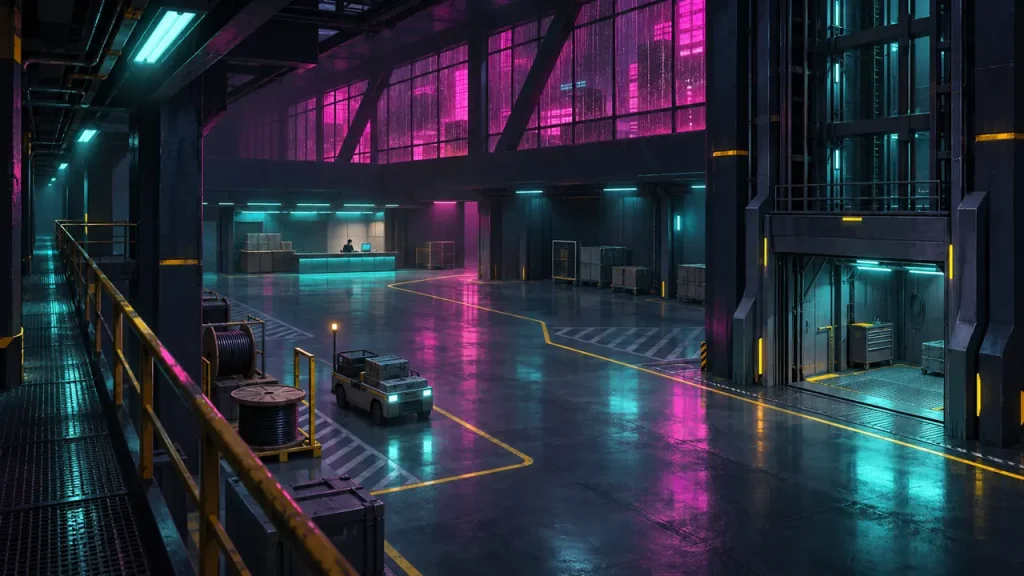
Service Ghost is a cyberpunk concept built around the ordinary work that keeps a tower district operating. The player is a street netrunner who studies maintenance routines and chooses where an intervention can fit. Instead of treating a credential as a universal key, the design asks what a particular permission allows, where it applies and when it stops making sense. This is a fictional game proposal, not a real-world security guide or an announced release.
Read the job before entering it
A service request creates a chain of expectations. A component needs inspection, a crew requires a lift, and a receiving desk expects a handover. The player observes the visible parts of that chain through the district rather than reading a complete answer in a menu. A useful clue links two ordinary events: a cart waiting beside a lift and a work notice at the next floor. Reconnaissance should establish why people and objects move, so that a later change has a recognisable consequence.
Permissions belong to a context
Temporary access is proposed as a relationship among a role, a task and a place. A maintenance window may permit a specific service passage while leaving the public lobby unchanged. The player should see those limits before acting. The concept does not reward guessing an invisible rule that only becomes apparent after failure. A fictional route card can summarise the current expectation, the next handover and the condition that closes the window. This gives temporary access more meaning than a countdown attached to a coloured badge.
Intervene without freezing the district
The world should continue its ordinary work while the runner acts. Delaying one handover may affect a later inspection, but it should not cause every person in the district to stop and stare. We want consequences that follow the dependency being changed. If the player interrupts a component transfer, the receiving point may ask where it went. If they finish early, another movement may become possible. The proposed system would need clear boundaries so that a small encounter remains understandable rather than pretending to simulate an entire city economy.
Keep an exit inside the plan
A routine that grants entry may not provide the same route out. The runner needs to know whether a service lift remains available after a handover, or whether returning through a public corridor is more appropriate. The plan can include a modest result and a clean departure instead of a maximal intervention. We would avoid a final surprise that invalidates every previously explained route. When a condition changes, it should do so with enough visible evidence for the player to reconsider before commitment becomes irreversible.
A quieter form of cyberpunk detail
The visual direction concentrates on service labels, cable runs, occupied thresholds and sheltered working areas beneath the spectacular towers. Readable fictional signs can be produced as interface elements rather than baked into concept art. Magenta city light remains present, but cyan work lighting and small yellow interruptions help distinguish routine from exception. The player should recognise a maintenance space by its arrangement and use, not only by a glowing icon placed over its door. Sound and text alternatives need to communicate equivalent cues.
Questions before a playable claim
The concept still needs to establish whether a player can reconstruct a short service chain, predict one consequence of changing it and explain the boundaries of temporary access. No completed test or shipping schedule is implied. The Rainsplice concept explores a shorter, more concentrated intrusion, while the Street Lab explains our method for connecting environmental storytelling to a decision that can actually be read. Both projects remain concepts until those relationships have been tested in a working prototype.