
The Exit Belongs in the First Sketch
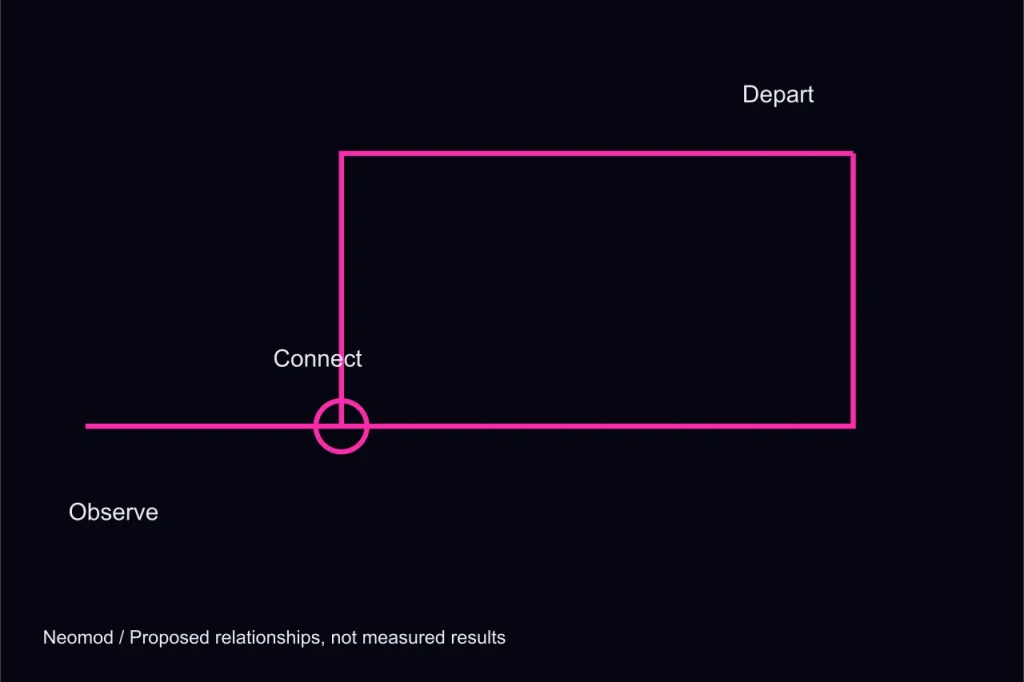
Observe: a good entrance can hide a bad encounter
A dramatic entrance is easy to sketch. The runner slips through a rain curtain, reaches a glowing cabinet and opens a connection beneath the towers. If the drawing stops there, the encounter may have no coherent departure. An exit added late can become a convenient door that appears only after success, or a long corridor that repeats the entrance without adding a decision. For Rainsplice, we want to place the retreat in the first route sketch, before the intrusion objective becomes the centre of the composition.
Trace a complete movement
The initial drawing needs three positions: where the runner observes, where they work and where they can go next. Each position should be connected by a route whose important conditions can be seen or inferred. A sheltered working point may require crossing an exposed strip of pavement. A nearby exit may lead into a passage too narrow to pass an approaching crew. Those relationships give the connection point a practical character. It is not simply a glowing interaction marker surrounded by decorative architecture.
Propose: compare two useful retreats
One proposed encounter offers a short return through the service entrance and a longer path beneath a public walkway. The first is familiar but vulnerable to a change in occupancy. The second is less direct but remains visible from the working point. Neither should be labelled the correct answer in advance. The player chooses a fallback based on the objective and the conditions they observed. A later warning can then refer to a route the player already understands, rather than introducing an emergency path at the moment it becomes necessary.
Make partial completion visible in space
The runner may leave before gathering everything they hoped to obtain. The departure route should support that outcome without turning into a punishment sequence. A quiet shelter beyond the immediate work area could provide a place to review the partial result. The scene does not need to celebrate every withdrawal, but it should let the player understand what happened. A useful result and an unresolved question can lead into another plan. Treating the encounter as a binary success screen would erase much of the intended decision-making.
Avoid a camera that argues with the plan
A close camera can make a cabinet interaction feel immediate while hiding the route the player is meant to monitor. We would keep enough peripheral context to recognise the relevant doorway or provide a stable, clearly limited route view. The solution should not imply omniscient surveillance of the whole district. It only needs to preserve the relationship established during scouting. If the player cannot tell whether an exit remains available because the interface obscures it, the difficulty comes from presentation rather than the fictional situation.
Check the route without the lighting treatment
The same encounter should remain understandable as a simple floor plan and a grayscale perspective. Strong neon can make a weak arrangement appear purposeful, but it cannot fix an exit that connects to nowhere. We would review sightlines, turning space and the point where the runner can reassess the plan. The art pass can then emphasise those relationships with shelter, reflections and changes in surface. This is a proposed review method; no claim is being made that the encounter has already passed a player test.
Connect the route to the warning language
Once the exit has a clear role, a warning can say which option changed. That is the relationship explored in A Warning Needs an Address. The Access Routes overview also compares Rainsplice with Service Ghost, whose departure may depend on a service handover rather than a short intrusion window. Drawing an exit early is useful in both concepts, but the reason it remains available should come from each game’s own loop rather than a shared escape-corridor template.