
Temporary Access Is a Relationship
Observe: the badge opens too much
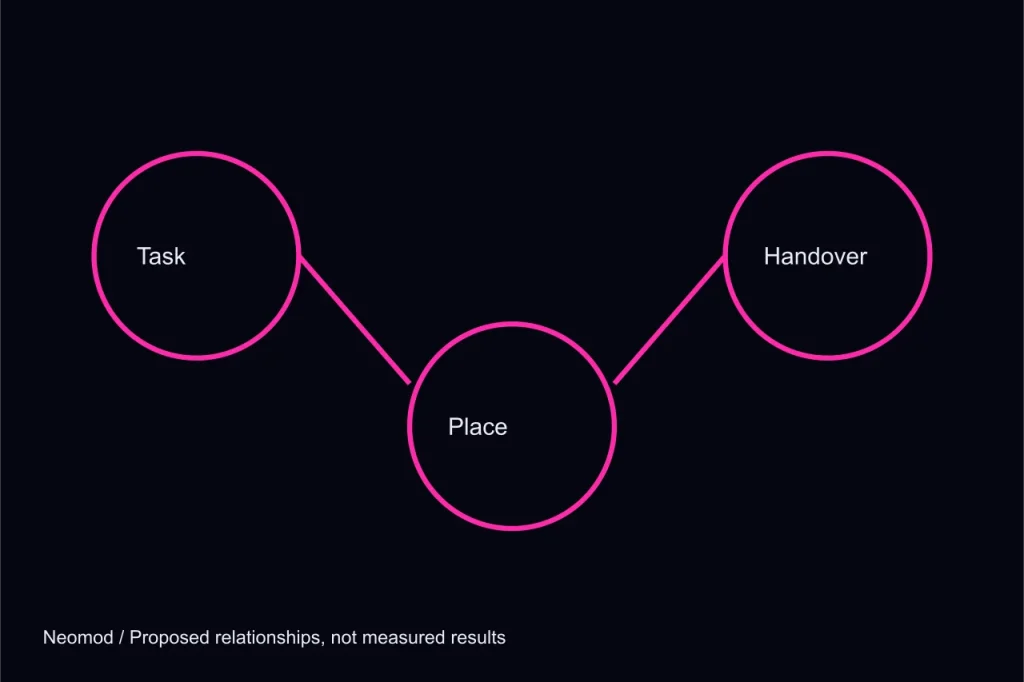
A temporary badge can become a convenient explanation for almost any door. The player obtains it, a timer appears and the district behaves as though every permission belongs to the same system. That arrangement is easy to communicate but leaves little room for understanding the work happening around the character. Service Ghost proposes a narrower idea. Access belongs to a particular task in a particular place, and its limits should be visible enough for the player to plan around them before crossing a threshold.
Begin with an ordinary expectation
Consider a fictional inspection job that requires a component to move from a receiving desk to a service floor. The desk expects a collection; the lift expects a scheduled movement; the service floor expects a handover. The runner studies those expectations through the environment. A waiting cart and an occupied work bay can communicate more than a generic access icon. The point is not to model an actual corporate security process. It is to build an understandable game situation in which an action makes sense because of its context.
Propose: describe the permission in a sentence
Instead of a badge labelled all access, the interface could state that the current task permits a specific service route until a named handover. That sentence gives the player three useful pieces of information: purpose, scope and ending condition. It should be accompanied by a simple route representation, not buried in a long fictional policy document. If an exception exists, it should be discoverable before the player relies on the permission. An unannounced exception is a surprise rule, not a satisfying consequence of observation.
Let the end condition be an event
A countdown can create pressure, but it should not be the only way temporary access ends. A completed delivery, a reassigned work bay or an acknowledged inspection can change what the district expects next. These events are meaningful because the player has already observed the chain. The interface can show that the permission is about to become irrelevant without pretending that every person shares an instantaneous global alert. Different parts of the district may know different things, within clearly explained boundaries of the fictional system.
Keep the runner responsible for a departure
If completing a handover ends access, the player needs to understand the route available afterward. Perhaps the service lift returns to a public floor, or a staff corridor remains usable for departure only. That condition should be part of the initial plan. We do not want the final interaction to trap the character through a technicality that the game never mentioned. A player can still make a risky commitment, but the risk should concern a relationship they had a reasonable chance to notice.
Check whether context survives a change
A useful concept exercise changes one part of the job while leaving the rest intact. If the receiving point moves, can the player explain which route changes and which permission remains valid? If every answer requires starting the entire encounter again, the model may be too rigid. If nothing changes, the context may be decorative. The aim is a small system whose dependencies can be reasoned about. This remains a proposed check for a future prototype, not evidence that a working simulation already exists.
Where the study leads
The Service Ghost dossier places this permission model inside a longer observational loop. Our Street Lab method asks the interface and route designers to describe the same relationship from different perspectives. A convincing temporary permission should change both what the player understands and where they can go. If it only changes the colour of a door icon, the concept has not yet connected its network fiction to the physical city that makes it distinctive.